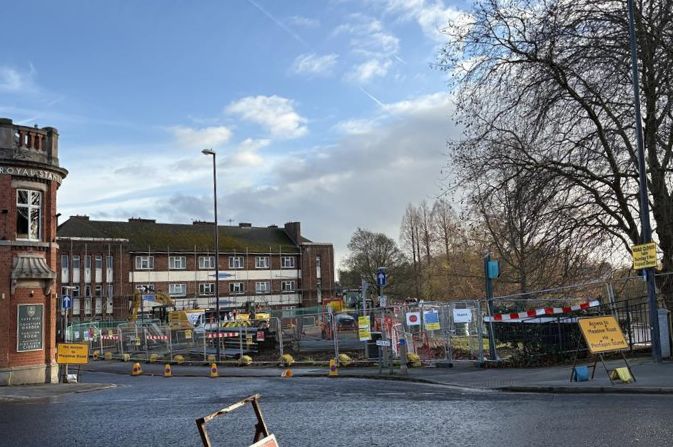
Caroline Douglass, Executive Director for Flood and Coastal Risk Management for the Environment Agency (EA) visited Derby today to see the transformation taking place on the riverfront. This visit caps off a successful first six months of partnership between the Council and John Sisk and Son on the latest phase of the Our City, Our River project.
The scheme, led by Derby City Council on behalf of the Environment Agency, is one of the largest infrastructure projects in Derby’s history. Since May, Sisk has been pressing on with Derby Riverside, a crucial part of the scheme to bolster defences on the left back of the Derwent.
Visible progress
The last six months have seen the landscape of the riverside area change rapidly. On Meadow Road, crews are hard at work redirecting utilities and dismantling old, ineffective defences to make way for a new state-of-the-art flood wall. This upgrade will ensure vital infrastructure, including Meadow Road and Darwin Place, can remain operational during a flood event.
The area has also been shaped by significant land clearance. November saw the start of demolition at Peat House on Stuart Street, while the old petrol tanks near Bio House on Derwent Street are being safely excavated and removed.
Mitigating tree loss
While the engineering works require the removal of some trees on the “wet side” of the defences, the Council and its arboriculturists have worked hard to minimise the impact. This tree removal is necessary as any left within the flood corridor would compromise the effectiveness of the defence network.
To mitigate the impact of tree loss, the project is midway through an extensive replanting programme that will see a huge gain in the number of trees in the city. Over 580 trees have been replanted so far, with a further 900 still planned to go in the ground, vastly outstripping the 574 that will have been removed by the completion of Derby Riverside.
The replanting scheme has captured the public imagination, with hundreds of households applying for trees, and more recently 24 local schools have signed up to receive trees in the new year.
Caroline Douglass, Executive Director of Flood and Coastal Risk Management for the Environment Agency, said:
Derby’s Our City Our River is a great example of partnership working between Derby City Council, Environment Agency and other delivery partners.
I’ve been delighted on this visit to see firsthand how the scheme has progressed in helping to protect local communities from the devastating impact of flooding.
The overall target is to reduce flood risk to around 1,500 homes and 700 businesses by the time the scheme is completed.
The work will also unlock regeneration opportunities and create green spaces.
Schemes like this one are more important than ever as we see the impacts from more storms and increasing rainfall events.
Councillor Carmel Swan, Cabinet Member for Climate Change, Transport and Sustainability, said:
It’s been great to welcome our colleagues from the Environment Agency back to Derby to showcase the excellent work that has taken place on OCOR, one of their largest local authority-led schemes.
I’m delighted with what we’ve been able to achieve with Sisk in such a short time, and I look forward to seeing the Derby Riverside continue in 2026.
We know all too well the devastating impact flooding can have on unprotected areas, but also how much of a difference high quality defences can make when faced with unprecedented water levels. With this package of works complete, even more properties will be protected as extreme weather events become more frequent.
Lee Long, Project Director for John Sisk and Son, said:
We are really pleased with the works undertaken so far, working with the local community to minimise disruption whilst achieving key early project targets. We will reach a major milestone in December, with Peat House fully demolished and areas enabled for Piling works to commence in January.
David Turnbull, Area Flood and Coastal Risk Manager – Derbyshire and Leicestershire for the Environment Agency, said:
The progression of this building phase marks another significant step in delivering the Our City Our River Programme and strengthening Derby’s resilience to the growing impacts of climate change.
While we cannot eliminate the threat entirely, we can work together to help communities adapt and thrive in the face of these challenges. The Environment Agency is proud to partner with Derby City Council on this vital journey, and we are delighted to see this complex but essential phase move forward.
Looking ahead
As the project moves ahead, more buildings around Stuart Street and Phoenix Street will be demolished, including Crompton House. However, OCOR remains committed to Derby’s heritage, with plans being prepared to carefully remove the historic clock and pillars with a view to repurposing them.
This clearance will pave the way for a new riverside park. This area will serve the dual purpose of acting as a vibrant public space for people to gather year-round, and as extra space for flood waters.
The outcome of this project will be a state-of-the-art flood wall and gates stretching from Causey Bridge to Holmes Bridge. When paired with their counterparts on the opposite bank and the Mill Fleam Pumping Station, these defences will create a secure corridor for flood water to flow through the city, protecting thousands of homes and businesses.