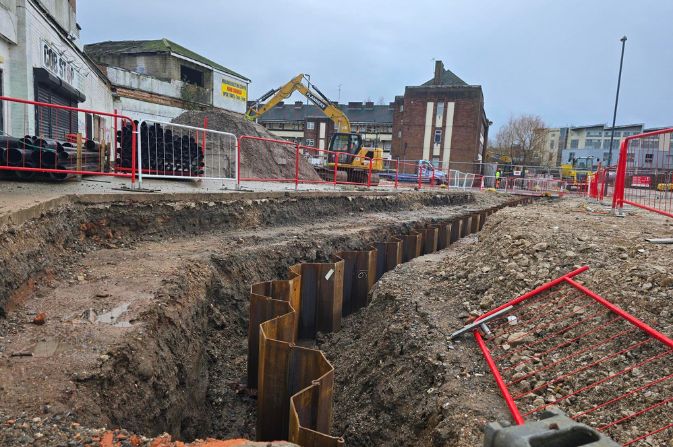
The transformation at Derby Riverside has progressed rapidly, as the city works towards a new era of flood protection for our city’s residents and businesses.
Derby Riverside is the second phase of the Our City, Our River project, a major flood defence scheme led by Derby City Council on behalf of the Environment Agency. Since May 2025, contractors John Sisk and Son have been working on Derby Riverside, a crucial part of the scheme to bolster defences on the left bank of the Derwent.
The Our City, Our River programme has already delivered enhanced flood protection to over 2000 properties. Once complete, Derby Riverside will extend this protection to the east bank of the Derwent and unlock the potential for regeneration in this part of the city.
With several existing buildings now being cleared, heavy engineering is getting underway at several sites as the Derby Riverside vision continues to become reality.
Laying the groundwork
New horizons have opened around Phoenix Street and Stuart Street following the demolition of Peat House, revealing new views of Derby Cathedral from the left (east) back of the river.
Work has now shifted to piling, an essential part of the construction process and the main component of the new flood defences.
To reduce disruption for residents and businesses on Stuart Street, contractors John Sisk and Son have utilised press-in piling machinery. This installs the piles without impact or vibration, with considerably less noise and disruption for nearby residents and businesses than traditional methods.
Piling is Also proceeding at pace on Meadow Lane and adjacent to Exeter Street and will soon begin adjacent to Meadow Road. The nearby industrial estate and Darwin Place Car Park are both highly susceptible to flooding but will benefit from the enhanced resilience the new defences will provide.
A one-way system is in place on Meadow Road to maintain access while essential work takes place, including moving utilities and to provide space for the piling machinery.
Although this may cause some inconvenience, it was preferable to a full closure of the road, as it maintains access to businesses and the city centre via a diversion and one way system. Contractors are in regular touch with businesses to keep disruption to a minimum.
Councillor Carmel Swan, Cabinet Member for Climate Change, Transport and Sustainability, said:
The transformation at Derby Riverside is already remarkable. We know all too well the devastation that flooding can bring to our community, but these new defences will be a game-changer when we are faced with unprecedented water levels.
I appreciate that some of the work has caused some temporary disruptions, but I am confident that this short-term inconvenience will be worth it for the long-term protection of businesses, homes, and infrastructure in our city.
The speed at which this project has progressed is testament to the hard work of both the Council and Sisk, and I’m excited to see things progress further over the coming months as we continue to build a more resilient city.
Lee Long, Project Director for John Sisk and Son, said:
Our Q4 2025 preparations have really paid dividends in January, with over 250 linear metres of piling completed since the new year restart on site. Our focus for Q1 2026 is to complete piling works adjacent to Meadow Road, a vital route to local businesses and the bus depot on Meadow Lane, and on Meadow Lane to allow the restoration of full access to the businesses there.
Our immediate plans are to complete another 400 metres of piling in the next 2-3 months and begin the redevelopment of the former Crompton House site. We thank local businesses and residents for their patience and collaboration as we work around their daily lives to complete this critical work safely and efficiently.
Heritage and engineering
Extensive modelling has been used to ensure the new defences provide the highest level of protection. This data-driven approach identified several buildings that must be removed to increase resilience for hundreds of businesses and homes when the river floods.
While Peat House has already been removed, work has progressed rapidly at Crompton House, which required following planning conditions to endeavour to save the clock if possible. When specialist teams were brought in to investigate, surveys revealed that the clock was not the single structure that it appeared to be from the ground. Mosaic tiles, many of which had been poorly replaced over the years, had been placed into rendering on a single brick wall, meaning it could not be safely removed in a single piece.
Both hands and the internal mechanisms, as well as the tiled pieces of the face have been preserved and will be transferred to the Council for storage while further options are considered.
Reflecting on the clock, Cllr Swan said:
Our surveys, carried out by heritage experts, showed that the clock was not well made, and removing it would cause damage. We are confident that the remaining parts of this piece of Derby History can remain in the city in one form or another, fulfilling the conditions of our planning application.
As with other demolitions as part of Derby Riverside, the removal of Crompton House was essential to ensure the new defences can effectively channel water through the city during a flood event.