Key public health documents and publications
Content accessibility
Some content in this section is presented in an interactive tool, which is not fully accessible. If you require the information in an accessible format, please contact the Public Health Intelligence team at PublicHealth@derby.gov.uk.
Microsoft have also published guidance on how to consume Power BI reports by using accessibility features.
Director of Public Health Annual Report
All Directors of Public Health have a duty to write an annual report on the health and wellbeing of their population. This report is used to highlight areas of particular concern and make recommendations for change.
This year’s report Climate Action: the benefits for our health focuses on the ‘win-win’ actions we can take that are positive for the planet and our health. The actions we take to address climate change do not exist in a vacuum; they also impact our health. When we walk to work rather than driving, we reduce the amount of carbon released into the atmosphere and we get some exercise.
The report includes:
- eight key topic areas where we can take action that is good for our health and the planet: clean air and transport, food systems, homes and buildings, green and blue spaces, education, jobs, health and social care and social capital
- the views of young people: 33 young people across Derby took part in focus groups to discuss climate and health.
Art competition
We also held an art competition, asking children and young people to express what a ‘green and climate friendly Derby’ looks like to them.
We received 200 entries, the winning entry is shown below and the highly commended pieces of art can be found throughout the report.
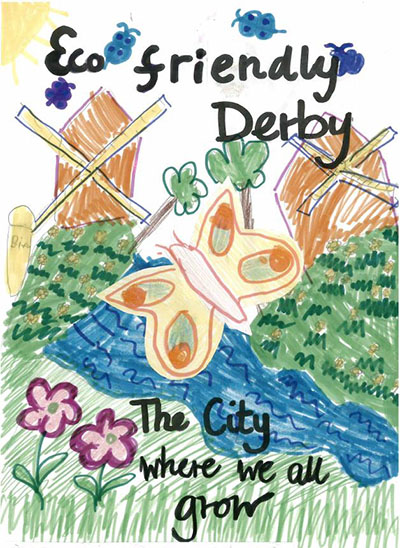
The report contains recommendations for what we can do to address climate change and improve our health.
Have a read of our report Climate Action: the benefits for our health, or watch the video below.
Additional documents
You can also read our previous annual reports.
- Public Health Annual Report 2023: Gambling with our Health
- Public Health Annual Report 2021: COVID-19 in Derby
- Director of Public Health Annual Report (DPHAR) 2017/18 How the Other Half Live
- Director of Public Health Annual Report (DPHAR) 2018/19:
Sexual Health Needs Assessment
Good sexual health is part of our everyday life. Preventing sexually transmitted infections (STIs) and unwanted conceptions is important for supporting good sexual health, but it is more than that. It is about promoting a positive approach to sexuality and sexual relationships towards fulfilling, safe and healthy experiences and helps to prevent unsafe behaviours that may lead to sexual exploitation and violence especially in vulnerable groups.
Good sexual health includes the physical, emotional, mental and social well being in a population, so it is important that the organisations who plan and purchase services (commissioners) and those who provide them (providers), work together.
Have a read of our joint 2023 Sexual Health Needs Assessment, Sexual Health Needs Assessment: Comparative Data and keep a look out for our new Sexual Health Strategy.
Tobacco Control Health Needs Assessment
Tobacco control involves using a number of different ways to help reduce the harms caused by smoking and tobacco use in our communities. This includes helping people who smoke to quit and preventing people from starting to smoke and becoming addicted to tobacco in the first place.
Smoking is one of the biggest causes of why people get sick and die early in England. It is also one of the main causes of health inequalities. Smoking increases a person’s risk of developing several serious health conditions, including heart disease, lung diseases and certain cancers. People living in the poorest areas are more likely to smoke and suffer from smoking-related illnesses than those living in the richest areas.
To be effective in reducing the harms caused by smoking and tobacco use we must all work together. This includes professionals and organisations whose work involves the planning, purchasing (commissioning) and delivery of services (providers) with a role in tobacco control.
This health needs assessment aims to support local commissioners and those who provide services in the development and delivery of their tobacco control work. It brings together the facts and numbers to:
- understand the impacts of smoking on people’s health and our communities
- understand what is currently happening with tobacco control work locally
- identify where there may be opportunities for further action to help improve the health and wellbeing of people in Derby.
Download the Derby Tobacco Control Health Needs Assessment. The Executive Summary provides a summary of the main points in full report. This infographic shows the main facts and actions identified from the needs assessment.
Cardiovascular Disease Health Needs Assessment
Cardiovascular Disease (CVD) is a general term for a group of circulatory diseases and conditions which affect the heart and blood vessels. This is usually caused by a buildup of fatty deposits around the arteries (atherosclerosis) which prevents blood flowing to the heart, brain or body. This can lead to health problems such as heart attacks or strokes. There are four main types of CVD long term conditions including coronary heart disease, strokes, peripheral arterial disease and aortic disease.
CVD is identified as one of the biggest causes of disability and deaths, accounting for a quarter of all deaths in the UK. It also remains to be one of the major drivers of people dying before the age of 75, particularly in the most deprived communities. Preventing and treating CVD is the single biggest area where the NHS can save lives over the next 10 years.
The NHS Long Term Plan commits to the prevention of 150,000 strokes and heart attacks by 2029, through the earlier detection and treatment of cardiovascular risk factors. With CVD being largely preventable by leading a healthier lifestyle, there are certain groups of the population at greater risk such as South Asian or Black ethnic minority groups and those within the most deprived communities. Some of the main risk factors associated with CVD include factors we have no control over such as – age, gender, ethnic background and family history. Whilst modifiable risk factors have a more significant role to play in the prevention of CVD and relate back to behaviours we control such as – smoking and alcohol consumption, physically inactivity and being overweight or obese.
This joint health needs assessment dashboard will aim to provide insight and recommendations of the current burden of CVD across the population of Derby and Derbyshire, with a particular focus on drilling into the level of need and healthcare inequalities, current service provision and any service gaps. This content will help support and inform local partners, health professionals and commissioners to influence decisions and help improve population outcomes.
Pharmaceutical Needs Assessment (PNA)
Derby and Derbyshire Health and Wellbeing Boards must prepare and publish a Pharmaceutical Needs Assessment (PNA). The purpose of the PNA is to assess whether there are enough pharmacies in Derby and Derbyshire and whether they provide the right services for local people now and in the future.
The PNA helps the local health and care system to:
- understand the pharmaceutical needs of the population
- understand what pharmacy services are currently provided
- inform decision-making on applications made to NHS England including the addition of new pharmacies to the pharmaceutical list
- commission appropriate and accessible services from community pharmacies
The latest Derby and Derbyshire Pharmaceutical Needs Assessment 2025-2028 is available to download.
Public Health Outcomes Framework
Health and wellbeing in Derby city in 2025
The Public Health Outcomes Framework (PHOF) brings together a wide range of Fingertips indicators that measure the health and wellbeing of Derby residents. It provides an overview of how Derby compares with England across the life course and helps identify where outcomes are improving and where challenges remain.
The 2025 PHOF results for Derby span the five PHOF domains:
- overarching indicators
- wider determinants of health
- health improvement
- health protection
- healthcare and premature mortality
It identifies indicators that are significantly better or worse than the England average, examines changes over time and highlights indicators where Derby is ranked within the worst 10% of English local authorities. The PHOF results also map the PHOF indicators to the County Health Rankings Model, providing an additional perspective on the wider factors that influence health and wellbeing.
At a glance:
- 189 Public Health Outcomes Framework indicators were analysed across five domains of health and wellbeing
- several indicators affecting children, working-age adults and older people are ranked within the worst 10% of English local authorities
- life expectancy, premature mortality, healthy weight, alcohol-related harm and falls in older people remain important public health challenges
- Derby performs significantly better than England for several indicators, including HIV late diagnosis, tuberculosis treatment completion, antibiotic prescribing in primary care, successful completion of drug treatment for non-opiate users and estimated dementia diagnosis rates
The findings show that Derby continues to face significant public health challenges. Many indicators relating to life expectancy, healthy life expectancy and premature mortality remain significantly worse than the England average. Health behaviours, including obesity, alcohol-related harm and physical inactivity, together with wider determinants such as school readiness, children living in low-income families and loneliness, also contribute to poorer outcomes.
Several indicators affecting children, working-age adults and older people are ranked within the worst 10% of English local authorities. These include:
- school readiness (year 1 phonics screening)
- adult overweight and obesity
- alcohol-related hospital admissions
- emergency hospital admissions due to falls in older people
- under-75 mortality from liver disease
- excess mortality among adults with severe mental illness
- emergency readmissions to hospital within 30 days of discharge
- preventable sight loss due to age-related macular degeneration
Alongside these challenges, Derby performs significantly better than England for a number of indicators. These include:
- timely diagnosis of HIV
- completion of treatment for drug-sensitive tuberculosis
- adjusted antibiotic prescribing in primary care
- successful completion of drug treatment for non-opiate users
- estimated dementia diagnosis rates in people aged 65 years and over
How Derby compares with England
The summaries show the proportion of PHOF indicators within each domain that are significantly worse than England , similar to England , and significantly better than England .
Domain A – Overarching indicators
81% of indicators are significantly worse than England, while 19% are similar to England. There are no indicators significantly better than England, highlighting the extent of challenges relating to life expectancy, healthy life expectancy and premature mortality.
Domain B – Wider determinants of health
46% of indicators are significantly worse than England, 31% are similar and 23% are significantly better. This presents a mixed picture, with challenges in early years, education, income, community safety and loneliness, alongside strengths in youth justice, employment and housing.
Domain C – Health improvement
43% of indicators are significantly worse than England, 45% are similar and 12% are significantly better. Challenges relate to obesity, alcohol-related harm, physical inactivity, cancer screening and falls, while Derby performs better in several areas including child development, injury prevention and substance misuse treatment.
Domain D – Health protection
53% of indicators are significantly worse than England, 38% are similar and 9% are significantly better. Lower vaccination coverage remains a challenge, although Derby performs well for HIV late diagnosis, tuberculosis treatment completion and antibiotic prescribing.
Domain E – Healthcare and premature mortality
55% of indicators are significantly worse than England, 42% are similar and 3% are significantly better. Premature mortality, emergency readmissions and preventable conditions remain a challenge, while estimated dementia diagnosis is the only indicator significantly better than England.
The PHOF 2025 Derby report provides an overview of Derby's health in 2025 and the wider factors that influence it. It offers a summary of Derby's assets and challenges and supports an understanding of the health and wellbeing of people living in the city.
Further information can be downloaded:
- Public Health Outcomes Framework (PHOF) 2025 – Derby report
- Public Health Outcomes Framework - at a glance summary - Derby 2025 [This file is not fully accessible - If you require the information in an accessible format, please contact the Public Health team at PublicHealth@derby.gov.uk.]